A blog by a veteran about living with PTSD, maintaining wellness, and everything else in between
You have to find your own way, but these posts may be useful guides along your journey.
Signs to heed if you are considering changing therapists

One constant I have found in my life has been change. This flux has touched my individuality, perceptions, and mental health. There is so much that can be different at any point in my life then why was it so difficult for me to switch to a new therapist when the one I was with was no longer able to assist me? A part of it was comfort. This was someone I had been seeing for years, they had come to know my traumas and pains almost as well as I do. I balked at the thought of having to start anew, to rip myself open and share what troubled me with someone different and unknown. However, what I failed to consider at times was what others told me and what I refused to see as ways to assess if I am doing better. When it comes to switching therapists it is not an easy decision to make. There are different factors that I had to take into account and I’ll point out what I learned when I switched to a new therapist.
The first steps into therapy for me were the most difficult. When I first started to open up it felt all-consuming. Things that were locked away are now spilling out everywhere. However, with time and care, I found that I was able to begin a process of healing. Unfortunately for me, when I was seeing my psychologist while in graduate school, I ended up staying with that person for much longer than I should have. There was even a point where the therapist mentioned to me that I should see someone else as they felt they could not be of any further help to me. I refused. I had come to know this therapist and I found a routine that allowed me to avoid tapping too deep into my trauma to promote further healing. Right here you can see one of the indicators that should have caused me to take a step back and reevaluate the efficaciousness of my therapy. My growth and improvement had stalled.
The difficult part is in how to quantify this. For myself, the indicators should have been that after multiple medical leaves from school I was not improving. I was stabilizing, but I was not becoming more resilient to provocative events that changed my emotional state and thoughts. An example was how I was still having extreme spikes in anxiety with being around crowds. This should have been a warning sign for me to at least consider if I should see a different therapist. There was another worry that arose within me that asking for another therapist meant I had failed or that I was never going to be able to get better. I had thought it was admitting defeat when this was furthest from the truth. I was accepting defeat and the current state of my mind by continuing to stay with the same therapist. Thus, I had become so consumed by my want for safety, comfort, and routine that I stayed with a psychologist that was not able to help me any further.
“There was another worry that arose within me that asking for another therapist meant I had failed or that I was never going to be able to get better.”
Besides stalling out in therapy another indicator for me was when I began to get worse. One big red flag I could identify easily was an increase in the number of times in a day when I thought suicide was a viable option and was planning more. Another red flag was when my wife had mentioned that she was not sure how much longer she could live this way. That led me to seek out couples counseling and since I was not able to get that promptly, where I was currently getting my care at that time, I had to reach out to an entirely different clinic. Once I did that I was paired with a new therapist, that helped me make further strides in my care. The impetus for this change was the honesty of my loved one letting me know that my current mental state was preventing her from being able to stay connected with me. This leads me to another good indicator for when it is time to change a therapist.
When I heard from others that I was doing worse I brushed them off. How could they know what I need? Don’t they understand how big of an ask that is? These types of questions led to an answer that I already knew. They were a masquerade of critical thought when instead I should have attempted to step outside my thinking and see if I can understand where they were coming from. I could more easily accept their perspectives when I asked questions and checked to see if I understood the points they were bringing up. This required me to put a pause on my judgment. What they were seeing at that time was that I was becoming more of a recluse and had a much shorter fuse than usual. The friends and family who loved me and saw my pain in ways I could not see for myself were a warning system that aided me in the transition of therapists.
Finally, one last consideration I considered was if I was being heard by my therapist. For instance, when I was at my worst and when medical school was no longer an option, I needed to figure out a way to gain financial assistance from the government. I asked my therapist to write a letter in support of my condition for my application for disability assistance. I will never forget the response they shared. They responded to my request with a snide remark, “Do you think money is going to make you happy?” The anger and disgust in their voice pained me in a way that I was not expecting. I needed a way to help provide for my family as I became more focused on my therapy. However, from the response of the therapist, there was no want to assist me in that endeavor. Instead, it was hard for me not to see how much of a burden I had become in their life. Once I shared what the psychologist had told me with others, my family and friends helped me to see it was time for a change.
Once I changed therapists, I knew I found the right one by looking at the converses of the markers I have already provided. I began to see myself doing more, pushing myself further than I had been able to go in the past, and I heard from others that I was doing better. The therapists who have helped me the most were the ones who challenged me, my thinking and provided multiple paths to move forward in mental care. Hopefully, these experiences of mine will help you understand if it is time for a change with your therapist. Be honest with yourself, withhold judgment whenever able, and talk with those you trust to see if transitioning to a different therapist might be better for your mental health treatment.
Ponchito: a canine source of assistance
Caring for a dog has helped me more than this blog post can state.
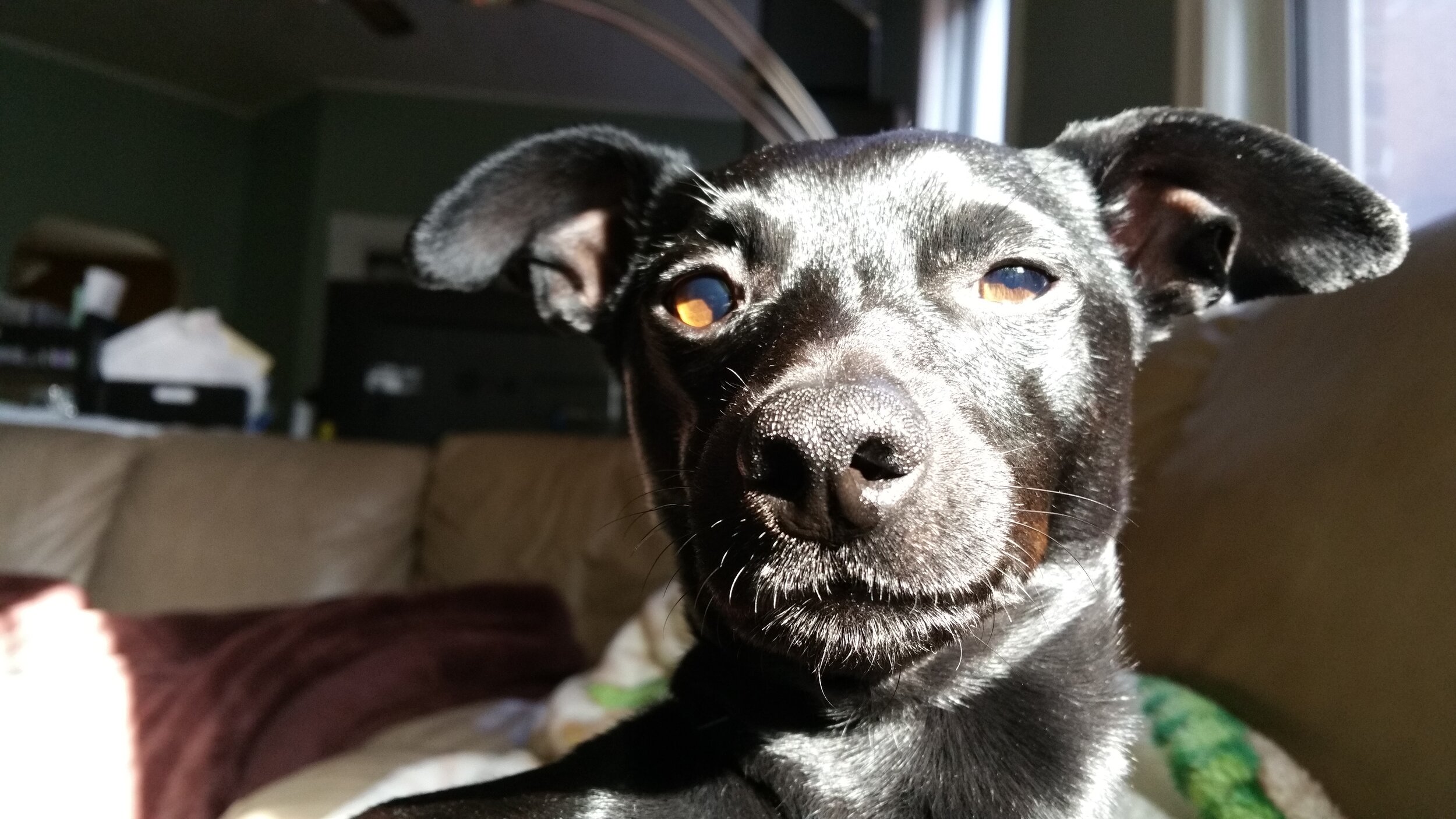
Striking a balance in life is, in part, done by improving and maintaining your mental and physical health. There are as many ways to do this as there are types of people. One huge source of support for my family and me to maintain balance has been our dog Ponchito. He is, as of this writing, a 10-year-old chihuahua mix, with short black fur, gangly limbs, and 17 pounds worth of dog. With all the spunk and personality he has, Ponchito can be quite the handful. In the process of connecting with him, building up a relationship, and coming to understand as much as I could of his mind, I became better associated with myself and the PTSD I live with. I have learned because of Ponchito, it is not the type of connections you have, but the quality and care you show for them that provides the biggest impact. If you are unsure if having an animal companion is for you this post may provide some insight as to why it may be helpful and the difficulties of taking care of another living, breathing being.
When I first met my wife, I did not understand she was a packaged deal. She did not know that either to be frank. What was originally envisioned between us as a duo became a trio that first night Ponchito stayed over my place with my spouse and me. As usual, I could not sleep that evening. In part because of this strange animal that continued to stare at me with big brown eyes as we prepared for bed, but also because at this point of my life it was difficult to sleep without waking up in terror. So, I would stir awake at random intervals in the dark and turned over to see him laying still as a rock. The catastrophizing in my head began swiftly, is he breathing? Airway, breathing, and circulation began percolating as questions in my head begging to be answered. I clenched my jaw and placed my hand upon his furry little chest afraid that he might be dead. There it was, the slightest bit of chest movement, and the solid thud-thud of his heart. Soon after finding the answers satisfactory, I was able to relax, breathe and my pulse finally slowed. This happened multiple times that night where I could have sworn, I had woken up to a dead dog lying next to us, but each time was proven wrong. I have heard of a similar situation of parents bringing home their newborn, but this was not my child, heck it was not even my dog! Yet the connection between him and I was beginning to grow. The fear and worry that pervaded my life would be one of the first things that brought us together.
This isn’t to say Ponchito and I hit it off at the first meeting. For instance, if I tried to pet Ponchito he would deftly move his head or jump away to avoid being touched. I figured it would just take some time for him to get to know me and left it at that. With time and attention, Ponchito would change from keeping me at a distance to curling up on my lap to sleep soundly or being on guard with eyes closed and ears perked for the slightest bit of sound. In those instances, Ponchito showed me you could be both at peace and alert.
Besides Ponchito’s demonstrations of balance, he was also a bridge for me to learn how to connect again with others. There was a variety of ways he did this and what helped the process was that he appreciates the importance of connection. After all, he would cuddle with me as much as I would let him. Usually, it begins with him scratching at my leg or my desk. That or if we were sitting on the same level surface it would instead be a paw upon my chest and a look into my eyes asking for space for him too. I hate to admit at first, I brushed him off. There was too much to study, to read, and pain to avoid that I could not give him space. However, he was persistent and insistent. If I would not give him space, then lying next to me at my hip was good enough. When he tried again maybe he would get lucky and I would let him curl up on my lap and I could feel the weight of him, his warmth, and that rhythmic breathing reminding me of his life. I did not understand it at first, but it distracted me from the judgment and blame that the hurt part of my mind heaped onto my shoulders. Instead of being stuck in the past here was that reminder to enjoy the present. It became more natural to pet him and stroke his fur and stay grounded for another little while. Rather than isolate as my mind was telling me to do, Ponchito helped me do the opposite. That aided me in seeing that perhaps I did not want to be alone or believe that others would be better off without me.
When my night terrors had me kicking and screaming at night. When I could not wake myself up from the memories that haunted me, and my wife was too drained to be awakened I could count on Ponchito. It was a surprise to wake up to Ponchito frantically rubbing his face into mine, but I recognized the smell and feel of his fur. Instead of opening my eyes and wondering if another mortar was incoming, I could ground myself in his embrace and the look of worry in his eyes. Even the slight whining noises he made conveyed the anxiety he and I were both feeling. I do not know if Ponchito understood what I was going through, but he figured out quickly enough how to get me to stop. This happened regularly enough that my appreciation for this dog grew from stunted ambivalence to fondness and finally love.
“…when I became so tightly enwrapped by my trauma, my pain, and sought a plan to ease my suffering I would see his dumb furry face”
I remember days as well so filled with dread and anxiety that I could only peek out the windows to make sure that I was safe. It was a glance sometimes because of a noise or a thought that danger lurked outside and was waiting to come in. This is where Ponchito helped me feel safer. As a chihuahua, he loves to bark at anyone and anything. That recognition that I could lower my guard when he was around, gave me some space to breathe. When he needed to walk, I would take him out to push myself. It became easier to go outside in large part because he was always on alert. Perhaps he could tell how high my anxiety was when I was around people and this is what drove him to have such vigilance. I appreciated it as it left me feeling safer. However, to truly become adjusted to everyday life in the US would still require me to participate in therapy and partake in medication. Here at least was some minor proof that relaxation was at the very least obtainable. Even if I was not ready to believe it to be true yet. This has become a source of difficulty later as he is not well trained, and it has been difficult for me to want to teach him to behave differently. I hope at some point to get rid of this security blanket of sorts, but currently, I prefer my dog “barky” so to speak.
Another positive I want to touch on was when my suicidal ideation reared its head. When all I could see was the soothing peace promised by eternal slumber, an image of Ponchito helped to ward off those thoughts. To assist with this my wife would send me pictures of him looking for me whenever it was that I left for school, work, or some other random errand. I am sure, even now, to receive some pictures of Ponchito looking out the window or a video where I will witness him whining and pacing on the wooden floor as he wondered where I could be. My dog was not the only thing preventing me from carrying out the thoughts of suicide, but he was a big reason why I have become so much more resilient. For instance, part of the therapy I underwent required me to create a plan of action or therapy plan for any suicidal ideation. It is a list of steps on how to combat the thoughts. First is recognition of the warning signs that help me realize the state I am in. Next up are coping strategies then phone numbers of people I can reach out for help and professionals I can get in contact with. An additional step I came to implement was thinking about the connections in my life and what my death would mean to those closest to me. Besides considering what my absence would mean for my wife, which itself was rife with problems, I could at least think of Ponchito.
As a dog, Ponchito has no sense of judgment from what I can tell. If I did not allow him to lay on my lap at any current moment he would come back later and ask again. In Ponchito’s big brown eyes I saw the acceptance for my life, for what I have been a part of, even if I could not allow it for myself. My heart still aches now when I consider that I would be so fortunate to have a being in my life that would love me not just for the good I brought into their lives, but also despite the difficulties and the pains. Even if I could not accept my life for what it was, here was Ponchito standing resolute despite my differing reasons why I was such a burden. So, when the time came for me, when I became so tightly enwrapped by my trauma, my pain, and sought a plan to ease my suffering I would see his dumb furry face. I could see him looking out the window and wondering where I was. Perhaps he had thoughts of when was I going to return and if he would get a treat may have entered his head. To think that I would disappoint him in that way. To move on from this life without him and leave him with just my shell to lay upon seemed to be the last straw. No matter how much I hurt inside, how warped my perception I can at least see clearly that I could not leave him waiting at the window in that way. There are those moments when I catch him looking at me, wide-eyed with hope and affection and I cannot help but smile back at him. We have been through quite a lot together and here is hoping we will enjoy many more years yet.
Before wrapping this up I do want to point out having a pet can be rewarding, but it also comes with its costs. Taking care of another life is not something that should be taken lightly or with nary a thought. Consider the average cost of a dog could be around $1,000 a year or so. Also having a pet requires proper care and training of the animal so they can recognize what is expected of them. This is a part I am still working on as the owner. It has also been difficult for my spouse and me to find apartments to rent whenever we attempted to move because a lot of places will not rent to pet owners. If you do not have a lot of space to care for your pet or do not understand the proclivities of a particular breed, then you may be in more for than you bargained for. Having a pet is not a panacea. You will not be cured and be able to say the pains of your life are no more, instead you can find more opportunities to grow as a person.
For me, Ponchito has taught me the importance of connection, balance, and my life. With this life, I want to honor his participation in it by loving him, my family, and at some point, myself.